More Information
Rose Porta and Sharon Jiang
Last updated on 2019-12-18
Further Analysis
GPA is one measure of academic success but it is not a full representation, so we also compared student birth year to two additional measures of success: selectivity of first postsecondary institution attended and mathematics self-efficacy score.
Selectivity of First Postsecondary Institution Attended by Birth Year

This barplot shows the proportion of students born in each year who attended a postsecondary institution within each category of selectivity. The scale is as follows2:
- 1: Highly selective, 4-year institution
- 2: Moderately selective, 4-year institution
- 3: Inclusive, 4-year institution
- 4: Selectivity not classified, 4-year institution
- 5: Selectivity not classified, 2-year institution
- 6: Selectivity not classified, less than 2-year institution
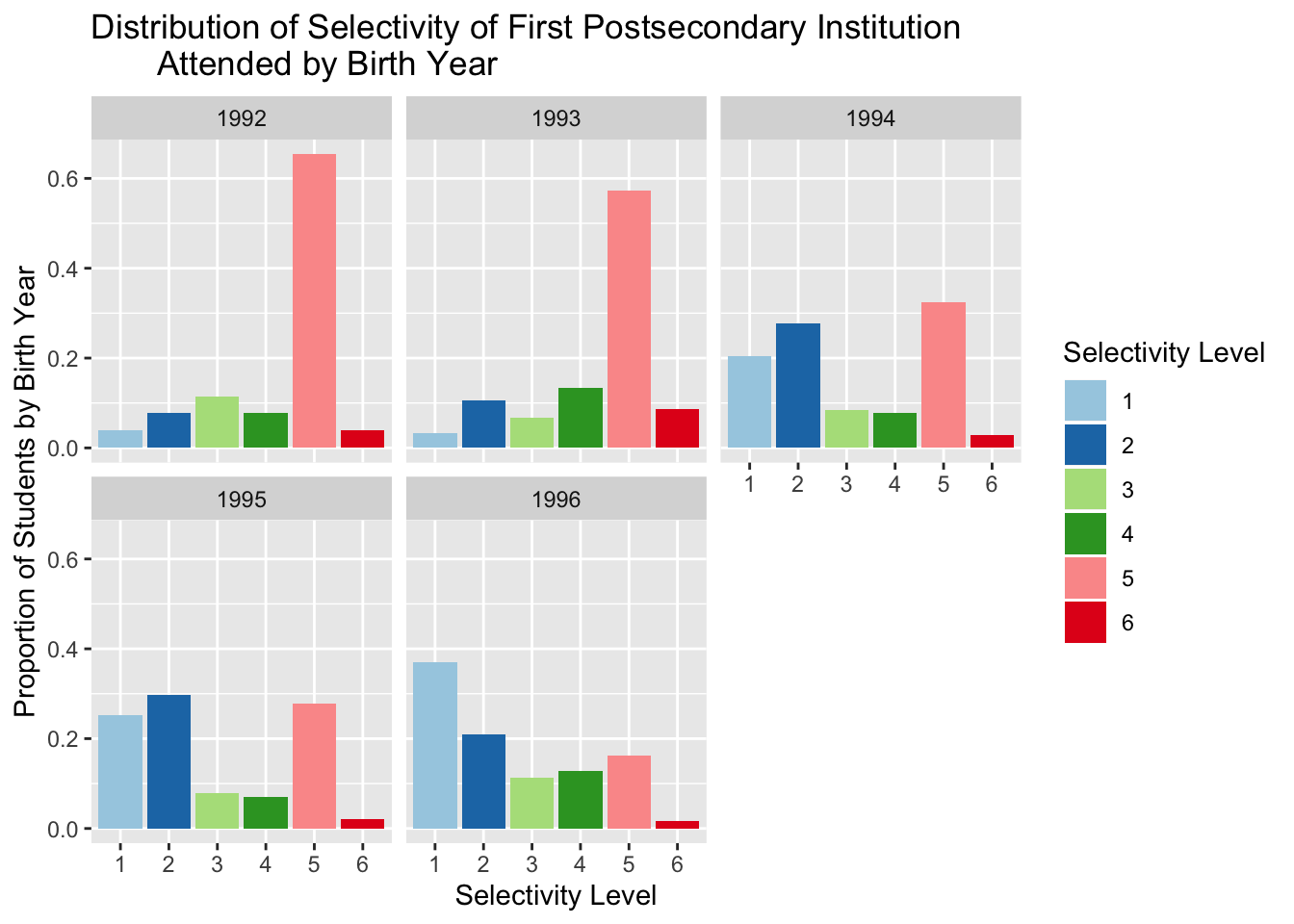
Like the results of our analysis of GPA, the graphs show that the vast majority of the students born in 1992 and 1993 who attended a postsecondary institution attended a 2-year institution where the selectivity was not specified, while very few attended 4-year institutions, which are generally more academically rigorous.
On the other end of the spectrum, the birth year 1996 has the highest percentage by far attending highly selective 4-year institutions. A possible explanation for this is that a large proportion of these students skipped a grade or were accelerated, which indicates that they are academically talented.
Even within the two years in which the majority of the students were born, 1994 and 1995, the results are consistent with the conclusion that the younger students are more academically successful. Although the proportions are all fairly close between these two years, it is clear that the percentages of students attending both highly selective and moderately selective 4-year institutions are higher for the birth year 1995 as compared to 1994.
Mathematics Self-Efficacy Score Versus Birth Year

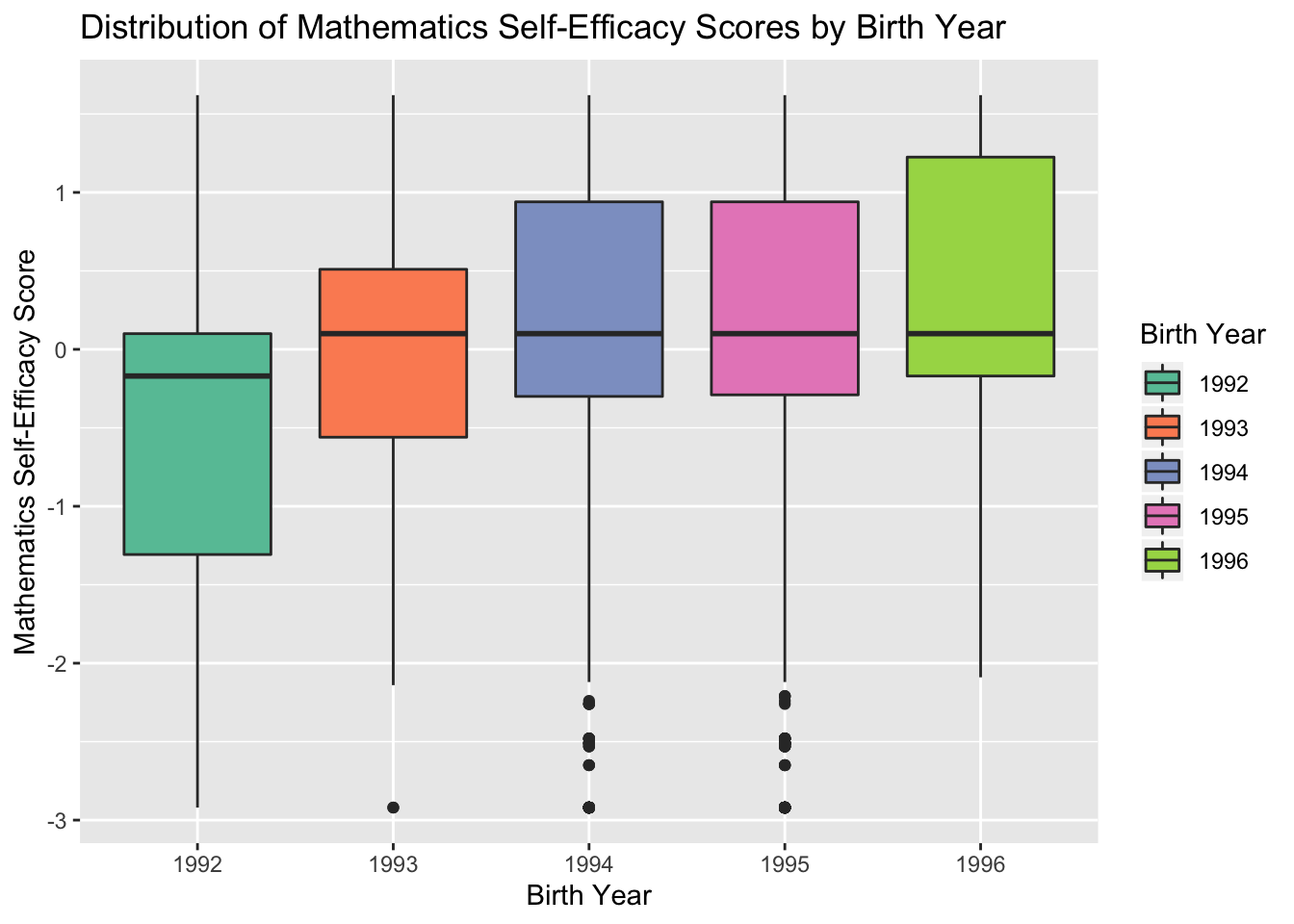
This boxplot shows the distribution of student mathematics self-efficacy scores split by birth year, with the values representing the number of standard deviations away from the mean the student’s score was. Self-efficacy is an interesting variable to analyze in relation to age because children who are held back before kindergarten will likely be more confident because they will be praised for being more mature than the other children, but those held back to repeat a grade may have their confidence diminished at a young age.
However, the graphs indicate that birth year does not have a significant effect on mathematics self-efficacy with the exception of the birth year of 1992, whose median score is significantly below that of the other birth years. Because there were so few students born in 1992, this result may simply be due to random variation. The medians for the other birth years are all remarkably close together, all very close to the overall mean of zero.
Conclusion
Overall, the results of our analysis contradict the popular belief that holding children back in school at a young age makes them more likely to succeed academically. Our analyses of GPA and selectivity of first postsecondary institution attended showed fairly consistent results indicating that older students from this sample were not as academically successful as the younger students. Our analysis of mathematics self-efficacy suggests that birth year does not have a significant effect on students’ sense of achievement in math.
Citations
“Post-Secondary Institution Visit Reports.” Richard Têtu’s Room: Tools and Memories, richardtetu.weebly.com/post-secondary-institution-visit-reports.html.↩
Online codebook for the Highschool Longitudinal Study of 2009, accessed at https://nces.ed.gov/OnlineCodebook/Session/Codebook/ba491cd0-c17f-479c-b695-4b11de2234ad↩
Algar, Selim. “Over Half of NYC Kids Can’t Handle Basic English, Math on State Tests.” New York Post, New York Post, 22 Aug. 2019, nypost.com/2019/08/22/over-half-of-city-kids-cant-handle-basic-english-math-on-state-tests/.↩