Is Holding Children Back an Effective Way to Increase Their Chances of Academic Success?
Rose Porta and Sharon Jiang
Last updated on 2019-12-18

Introduction
It is common practice either for parents to hold their children back an extra year before kindergarten or for schools to hold children back to repeat a grade, both done for the purpose of increasing the child’s probability of academic success, but are these practices successful?
To answer this question, we analyzed three measures of academic success: GPA, selectivity of first post-secondary institution attended, and mathematics self-efficacy score by birth year for a sample of over 25,000 9th grade students from schools across the U.S. using data from the High School Longitudinal Study of 2009, conducted by the National Center for Education Studies (NCES).2 The study collected data on the academic trajectories of these 9th grade students through highschool and into college.3
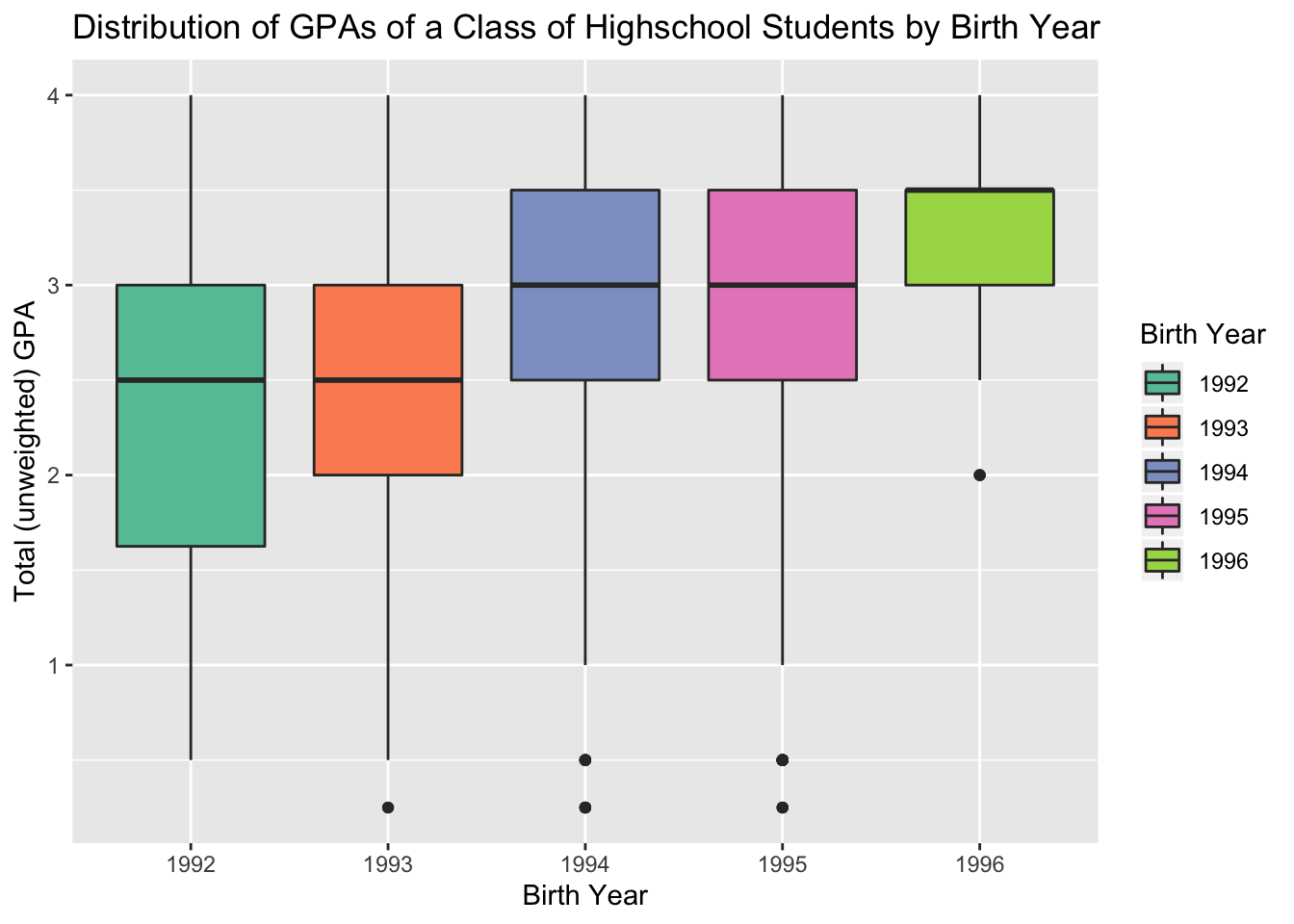
GPA Versus Birth Year
This visualization showing the distributions of unweighted total high school GPA, a standard, objective measurement of academic success, by birth year is surprising because it shows that the oldest students, born in 1992 and 1993, have significantly lower GPAs than the other birth years. Furthermore, the youngest students, born in 1996, have the highest median GPA. This is contrary to the belief that holding children back makes them more likely to succeed academically.
Citations
“Classroom Management for Middle School Teachers.” S&S Blog, S&S, 12 July 2019, www.ssww.com/blog/classroom-management-for-middle-school-teachers/.↩
High School Longitudinal Study of 2009 (HSLS:09) Base-Year to Second Follow-Up Public-Use Data File, retrieved from https://catalog.data.gov/dataset/high-school-longitudinal-study-of-2009/resource/942fd32f-c1d9-4509-a1c2-5eb1d98b1db2, supporting documentation accessed at https://nces.ed.gov/surveys/hsls09/hsls09_data.asp↩
Info about High School Longitudinal Study of 2009 retrieved from the National Center for Education Statistics website, https://nces.ed.gov/surveys/hsls09/↩